Phoenix’s divergence suggests more resilient local fundamentals—migration, job growth, and supply constraints. Nationally, median home prices were down ~0.6 % and pending sales were collapsing ~31 %, indicating broader weakness. The relative strength tempers downside risk in Phoenix-centric holdings. From tax revenue projections, this resilience helps sustain municipal forecasts. Policymakers may point to this in justifying infrastructure or housing policy. For value stability, the local cushion provides greater breathing room than many other U.S. markets.

The strong ranking reflects robust ongoing industrial construction and leasing activity. The industrial sector is becoming a backbone of Phoenix’s commercial real estate, driven by e-commerce, supply chain re-shoring, and proximity to western corridors. For investment portfolios, industrial real estate offers lower vacancy volatility and stable lease cash flows. Municipal entities may prioritize infrastructure (roads, power, broadband) servicing industrial clusters. From zoning/regulation angles, industrial corridors may see new overlays or incentives. In resilience terms, industrial capacity tends to be less cyclical than residential or retail.
While Phoenix was ranked the #1 industrial market in Q1 2025 (67.5 score) supported by strong demand and construction activity, its office sector is under pressure as occupancy and leasing lag under hybrid work and tenant caution. The contrast underscores bifurcation: logistics, warehousing, last-mile functions are thriving, while traditional offices are realigning to flexible formats. For real estate allocations, diversified industrial exposure gives ballast, while office repositioning may be necessary. On taxation, underutilized office buildings may trigger reassessment or incentive programs. Regulators and planning departments may ease repurposing rules to convert offices to residential or mixed use. Value resilience tilts toward industrial, mixed, or adaptive-use assets. In smart-city planning, enabling conversions to residential/innovation spaces may recapture obsolescent office corridors.
Notable transactions include a 322,070-sf Southwest Valley asset sold for ~$48.83M in December 2024 and a separate Tolleson industrial acquisition for $36.05M in May 2025, underscoring sustained investor appetite; council agendas through mid-2025 reflect standard governance on claims, bills, and road projects as the city manages growth near I-10/Loop corridors. Wealth strategies can position around infill logistics nodes. Tax receipts benefit from stable single-tenant leases. Regulatory cadence remains steady via council approvals. Values in core logistics lanes are underpinned by tenant credit and access. Smart-logistics features include trailer parking and secure truck courts.
In Q1 2025, Phoenix posted the top score among U.S. industrial real estate markets with 67.5 points — driven by ongoing construction volume, leasing demand, and favorable fundamentals. The region benefits from intermodal connectivity, access to key highways, and relative land availability. For institutional investors, such industrial strength diversifies real estate exposure beyond residential. On taxation, growth in industrial valuation supports local tax bases and infrastructure funding. Regulatory attention is focused on improving permitting for warehouse/distribution facilities. In terms of value stability, industrial real estate often exhibits less cyclic volatility than residential. In smart-city layering, last-mile logistics, electrified fleets, and automated warehousing may further boost premium rents.
Among them is a project of ~1,300 units (Optima McDowell Mountain) with extensive retail and open space, a live-work district tied to Axon’s HQ, a multi-building “Parque” project combining hotel, retail, and residences, and expansions in office / innovation campuses. These projects reflect confidence in Scottsdale’s premium positioning. For high-net-worth allocations, these may offer differentiated yield profiles. Zoning and approvals remain key risk levers. Such densified, compact projects align with smart city and sustainable growth priorities.
A September 2025 report details impact-fee fund balances and system-area consolidations under the updated rate study, including consolidating multiple water and wastewater service areas; the Utility Billing page confirms the active study guiding council on future rates and fees. Wealth planning for infill and hillside product should include potential fee adjustments. Taxes and fees fund water resiliency, slope stability and fire-wise infrastructure. Regulation is driven by the Land Development Code and P&Z hearings. Value stability benefits from infrastructure investment pacing. Smart-city elements include GIS service-area mapping and data-driven fee models.
The city’s Downtown Campus Reinvestment initiative outlines renovations to City Hall, the parking garage, council chambers and adjacent facilities, signaling long-life-cycle upgrades to public spaces that support surrounding private investment and event activity; council meetings and planning hearings through mid-2025 also tracked zoning text amendment considerations, underscoring an active policy pipeline. Wealth and family office strategies view civic improvements as tailwinds for nearby assets. Tax capacity benefits from rising property and sales activity in revitalized cores. The regulatory context coordinates capital planning with zoning updates. Value durability ties to institutional anchors and placemaking. Smart-city integration spans safety, traffic and digital public-service access.


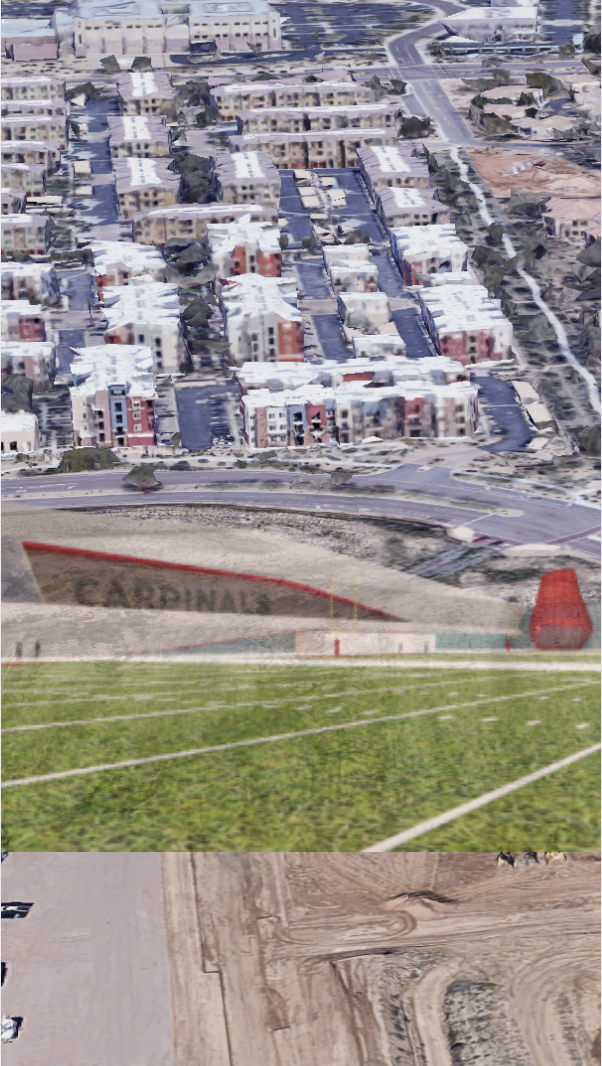 Arizona Cardinals’ $136 Million “Headquarters Alley” Project: How a 217-Acre Deal Will Redefine North Phoenix by 2028
 Public Safety as an Asset Class: The New Scottsdale AdvantageIn today’s Smart City economy, safety isn’t simply about peace of mind—it’s becoming a measurable, marketable asset class. Scottsdale is proving that public safety can be engineered into the fabric of
Nice to meet you! I’m Katrina Golikova, and I believe you landed here for a reason.
I help my clients to reach their real estate goals through thriving creative solutions and love to share my knowledge.