On June 24, 2025, Maricopa County Board of Supervisors adopted a zoning amendment streamlining approvals for mixed-use and high-density multifamily developments within transit corridors, notably along Central Phoenix, Tempe, and Mesa. The regulatory change reduces conditional use permit timelines by up to 40 days and introduces density bonuses for incorporating renewable energy or affordable units. This framework increases certainty for institutional portfolios and supports urban-infill wealth management strategies. Property tax implications center on the shift from commercial to higher-density residential assessments, which can affect long-term cash flow models. Future-proof development is further supported by new requirements for gigabit-ready digital infrastructure in all new multifamily projects.

A new analysis shows that Phoenix developers managed—temporarily—to outpace demographic growth via multifamily construction between 2022 and 2024. But that momentum is already fading, and forecasts suggest population growth will again overtake housing additions by 2026. The short-lived balance eases pressure on pricing, but rising costs and tight credit may prevent a sharp downturn. For portfolio holders, this grants limited downside buffer. On the policy side, it may moderate calls for emergency incentives. In terms of long-term value, locations with strong fundamentals remain safer bets as supply and demand re-equilibrate.
Phoenix’s purchase marks a concrete step in the “Rio Reimagined” program involving Avondale, Buckeye, Mesa, Tempe, Maricopa County, and tribal partners. The acquired parcel (currently occupied by Ace Asphalt) may be cleared for future mixed-use, public space, or waterfront activation—though design plans are pending. The local segment, called RIO PHX, spans 20 miles. The entire plan is projected to unfold over 25 to 40 years. For investors, this signals commitment to long-horizon catalytic infrastructure. From a tax and municipal finance lens, future incremental value gains will factor into special districts or assessments. Regulatory and land-use coordination will be essential across jurisdictions. In a sustainability sense, visioning around water, habitat, mobility, and open space will influence real-estate outcomes.
In the Phoenix region, more home sellers are withdrawing listings than in any other U.S. metro, in part due to pricing mismatches, interest rate headwinds, and buyer caution. That rate of delisting is nearly double the national average. Many homes that remain active also endure longer days on market and more price reductions than in past cycles. For wealth portfolios, this trend suggests heightened liquidity risk in residential holdings. From a regulatory angle, local councils may revisit incentives or “time-to-sale” standards. In terms of long-term positioning, neighborhoods with stronger fundamentals (location, transit access, services) should retain relative value under this pressure.
In April 2025, nearly half of Phoenix’s listings had stagnated, held on the market beyond 60 days without going under contract. Median listing duration in May reached 58 days, exceeding the U.S. average of 50 days. This higher “staleness” reflects slack demand or pricing mismatch. For investors and homeowners, it raises expectations of negotiation room. On the municipal side, slower turnover can dampen property tax growth. From a value stability lens, assets in high-amenity or infill locations are more insulated; peripheral or speculative product is more exposed.
Demolition of the old Metrocenter mall is nearly complete. Construction is slated to begin in April 2026 on three residential communities, with the remaining two phases starting in April 2027. Plans call for 350 apartments (in “Levante”) plus 800–1,000 townhomes, along with retail, event venues, plazas, pedestrian and bike circulation, and landscaped public spaces. This large-scale infill project reflects a shift toward dense, mixed-use redevelopment over traditional retail-only form. In terms of real-estate strategy, it will reshape density, traffic flows, and value corridors in north Phoenix. Zoning changes, infrastructure upgrades, and public realm investments are already being aligned. Sustainability and smart-growth principles are embedded via walkability, transit connections, and mixed function.
Phoenix has recently seen residential development edge ahead of population growth, especially driven by multifamily projects between 2022 and 2024. However, that momentum is already softening, and analysts predict population growth will again outstrip housing supply by 2026. This brief balance offers some breathing room for affordability, but persistent high mortgage rates continue to constrain buyer activity. For investors, such interludes can moderate risk, though structural fundamentals (land availability, infrastructure costs) retain outsized influence. Policymakers may point to this data in legislative debates over housing incentives or zoning flexibility, while sustainability goals must reconcile densification with water and energy constraints.
The renovation plan will cover core infrastructure upgrades: air-conditioning, roof systems, structural repairs, and modernization. The financing structure relies on long-term sales tax revenue from stadium-area activity over 30 years. The move aims to keep the team in Phoenix past current lease expiry (2027) and catalyze downtown revitalization. For adjacent real estate, improved amenity, foot traffic, and confidence in permanence may yield spillover benefits. On tax policy, the match-plus-capture model offers one template for anchoring public-private urban assets. In portfolio terms, stakes in nearby blocks may gain relative arbitrage. From a resilience standpoint, modern systems may reduce energy loads and support year-round usage.


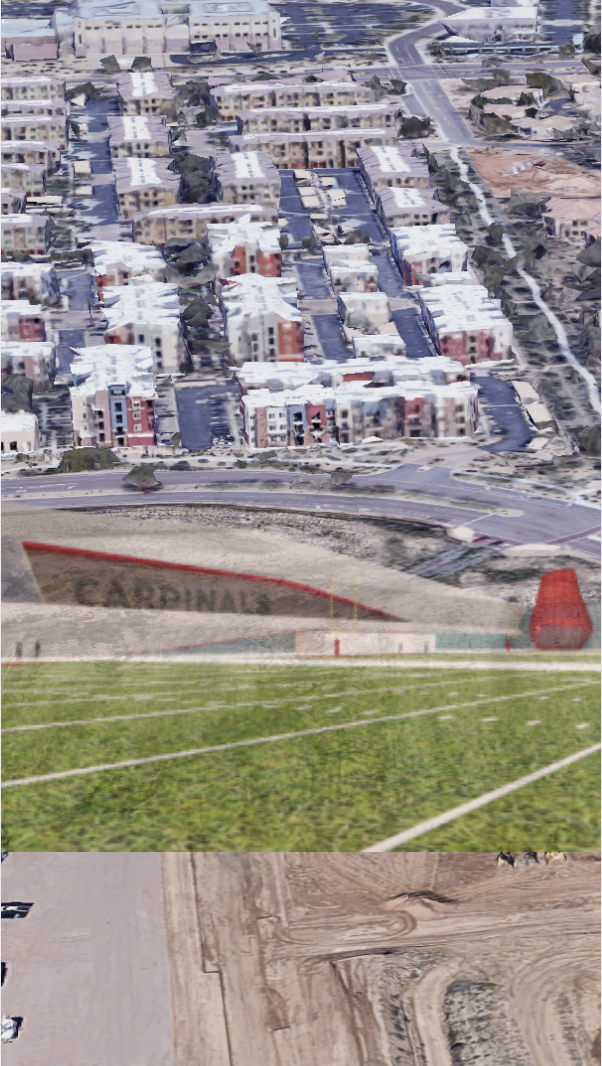 Arizona Cardinals’ $136 Million “Headquarters Alley” Project: How a 217-Acre Deal Will Redefine North Phoenix by 2028
 Public Safety as an Asset Class: The New Scottsdale AdvantageIn today’s Smart City economy, safety isn’t simply about peace of mind—it’s becoming a measurable, marketable asset class. Scottsdale is proving that public safety can be engineered into the fabric of
 Loop 101’s Smart Expansion: How the Raintree Drive Interchange Is Shaping Scottsdale’s Next Mobility EraThe Loop 101 (Pima Freeway) corridor in north Scottsdale is undergoing one of its most consequential upgrades in years — widening from Princess Drive/Pima Road to Shea Boulevard and reworking
  Adobe-Inspired Wall Finishes: Reviving historic textures with clay plasters and natural limewash tones for modern contextsAcross cities like Santa Fe, Tucson, and Albuquerque, there is a renewed appreciation for adobe-inspired finishes—wall treatments that reconnect modern living with the deep cultural lineage of clay
Nice to meet you! I’m Katrina Golikova, and I believe you landed here for a reason.
I help my clients to reach their real estate goals through thriving creative solutions and love to share my knowledge.